
Reader’s theater is one of my favorite ways to improve reading fluency, comprehension, and engagement in the middle school ELA classroom.
Emergency ELA Sub Plans
🎁 Join my email list for a free set of my ELA Sub Plans!
While I love reading aloud so my students can hear fluent reading, I also want them to practice fluent projection and inflection. With reader’s theater, students take on simple character roles that let them practice expression, pacing, and confidence.
If you are looking for reader’s theater scripts for middle school students, this post shares simple ways to implement reader’s theater along with printable scripts that work especially well with grades 5–8.
As teachers, we need to create scenarios to hear our students read. These are some of the reasons I love using reader’s theater scripts for middle school language arts. Students always enjoy “performing” the stories, and each script provides opportunities to incorporate word work, journal writing, and reading comprehension activities.
I have created over 24 reader’s theater scripts for my teacher toolbox to help my students practice their skills. The key to an engaging script is offering a story they can relate to as “big kids” in middle school. This was my goal in creating the different resources featured below. Most of these scripts have 10 to 12 speaking parts and take 20 to 30 minutes to read aloud.
Scripts for Every Season!
Reader’s theater is a fun way to incorporate the holidays and changing seasons while staying on task with your language arts lessons. The days leading up to a long weekend or holiday break can be challenging ones to keep students engaged. My reader’s theater bundle gives you a print-and-go script for every season in the school calendar!

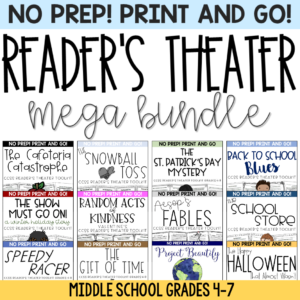
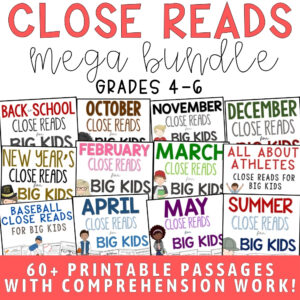
The bundle includes 12 reader’s theater scripts for middle school, and each one is a separate PDF toolkit with word work and comprehension activities related to the story. The bundle covers Back to School, Halloween, Thanksgiving, Christmas, Valentine’s Day, St. Patrick’s Day, and Earth Day. In addition, the bundle includes 5 evergreen scripts you can use throughout the year. Most teachers use these in their 5th- and 6th-grade classrooms. See the full description on TPT.
Evergreen Beginners Script
If you are new to reader’s theater, then I recommend trying The Cafeteria Catastrophe as an easy way to experiment with the concept. This printable PDF script features 11 characters and includes 3 different comprehension activities. Your students will stay engaged as they follow the “drama” that unfolds in this fun storyline.

This popular script is for 4th, 5th, and 6th grade teachers. The story follows a student who plans to run for student body president but makes a bad choice by stealing from the school cafeteria. This results in a few undesirable consequences. Your middle-grade readers will love the chance to step into the characters and decide what happens to Clara. See full description on TPT.
Specialty Scripts for Middle Grades
Beyond seasonal themes, I have several specialized scripts to accompany a certain book or discussion topic that we cover during the year. Some of these were created specifically to add more rigor to read-alouds I’ve done in the past.
Aesop’s Fables
If you are looking for a fun way to teach fables to your middle grade students, this Aesop’s Fables Reader’s Theater Toolkit has everything you need. Some schools introduce fable study as early as 3rd grade, but I’ve used this primarily with grades 4-6.

This resource includes 4 scripts. Each is a single-page, 3-character script with corresponding reader response questions. Your students can build fluency, strengthen comprehension, and learn about the fable genre in a FUN way! The fables are The Fox and the Crane, The Fox and the Cat, The Wolf and the Crane, and The Town Mouse and the Country Mouse. See full description on TPT.
The Day the Colored Pencils Resigned
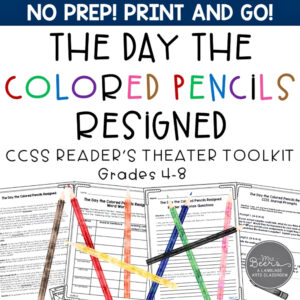
One of my favorite read-alouds is The Day the Crayons Quit by Drew Daywalt. I loved this book so much that I created my own, even FUNNIER, version to use with my students. Students can read the original picture book and then compare and contrast similar texts in this unit.

This printable PDF script follows Brennan, a student who puts minimal effort into his art project. His colored pencils notice and decide enough is enough; either he puts in more effort and considers their suggestions, or they may not return. Your students will have a BLAST acting out this hilarious script. See full description on TPT.
Celebrating Student Talents
In my class, we always celebrate our peers’ unique talents. The Pep Rally builds on this idea by telling the story of a 6th-grade class that works together to recognize each student’s amazing talents and accomplishments. This is the latest script I created, and I love how it gets students thinking about the awesome things their peers do outside the classroom.

The Pep Rally toolkit includes a 7-page, 13-character script with context-clue word work, reader-response questions, and journal prompts for comprehension activities at the end. Learn more about this resource on TPT.
The Tell-Tale Heart
The Tell-Tale Heart is a short story by Edgar Allen Poe that middle schoolers often love. My reader’s theater adaptation of this scary tale will get your students thinking more deeply as they take on the roles of the narrator, the old man, and the police officer.

This fun script works well for Halloween or Valentine’s Day and can differentiate your lesson plans. While the 3-page, 3-character script is short, students often find the discussion and literary analysis engaging. The toolkit includes a context-clue worksheet, multiple-choice reader-response questions, extended-response choice questions, and 3 journal prompts. See full description on TPT.
Why Reader’s Theater?
While I list the Common Core standards these toolkits cover below, I believe the benefits of an activity like this go beyond standards. Creating opportunities for our middle school students to read is tough to fit into instructional time. These scripts make it easy to fit in fluency practice while also giving “big kids” a fun activity to look forward to.
Common Core Standards
Each of my reader’s theater scripts and comprehension toolkits covers one or more of the Common Core standards below.
CCSS: 6-8 RL 1 Cite textual evidence to support analysis of what the text says explicitly as well as inferences drawn from the text.
CCSS: 6-8 RL 2 Determine a theme or central idea of a text and how it is conveyed through particular details; provide a summary of the text distinct from personal opinions or judgments.
CCSS: 6-8 RL 3 Describe how a particular story’s or drama’s plot unfolds in a series of episodes as well as how the characters respond or change as the plot moves toward a resolution.
CCSS: 6-8 RL 4 Determine the meaning of words and phrases as they are used in a text, including figurative and connotative meanings; analyze the impact of a specific word choice on meaning and tone.
CSS 6-8.W.4 Produce clear and coherent writing in which the development, organization, and style are appropriate to task, purpose, and audience.
Free Scripts to Download
Not sure if reader’s theater fits your ELA classroom? Below are a few free scripts you can download and try with your students. Each is formatted similarly to the PDF versions I have available in my TPT store. You can also join my email list below, and you’ll get a free script to try after you sign up!