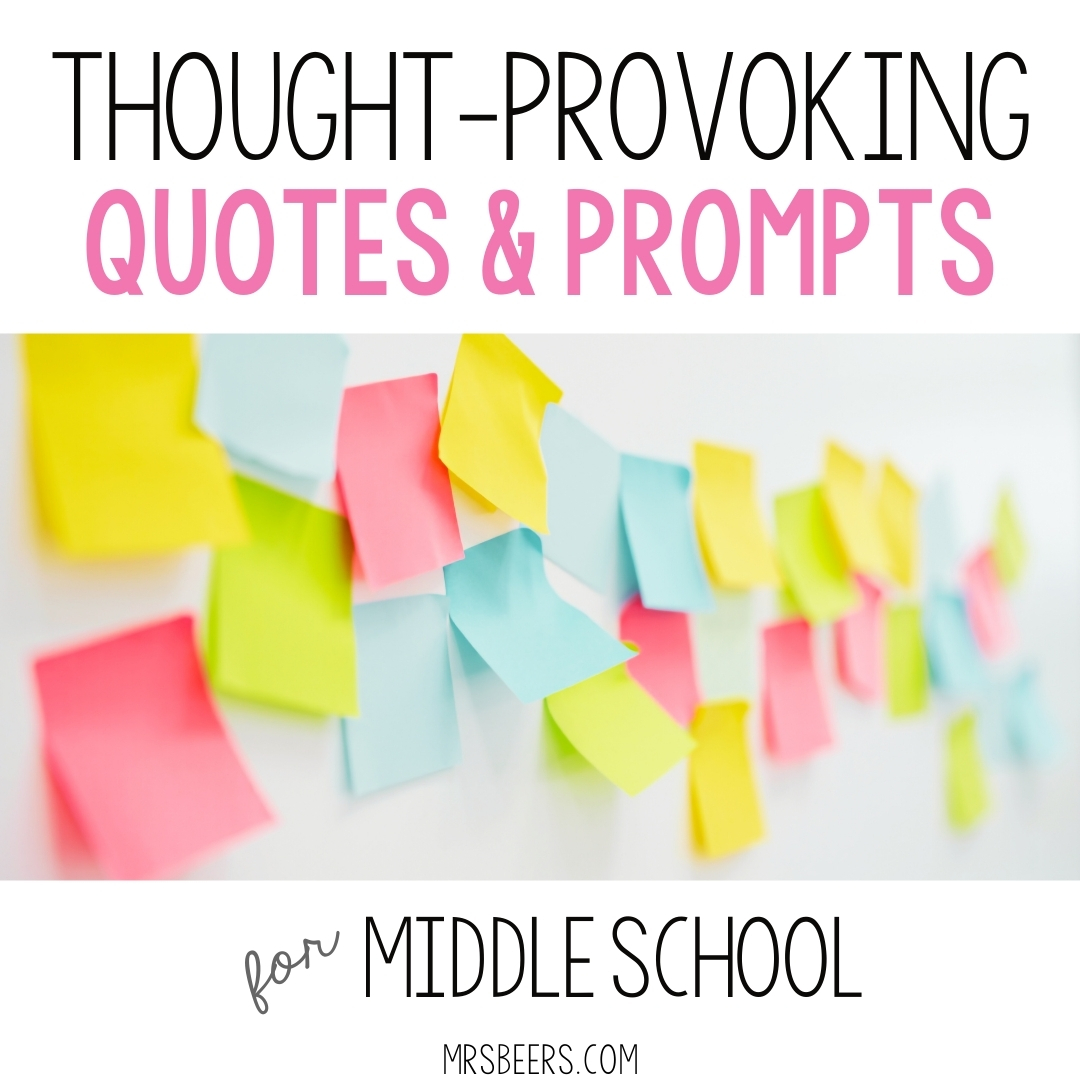
Some of the best classroom conversations begin with a simple quote that gets students thinking.
Emergency ELA Sub Plans
📨 Don't forget to join my email list for a free set of my ELA Sub Plans!
When middle school students are presented a quote that makes them pause and think for a moment, it naturally opens the door for deeper conversations and writing responses. I like to use little sayings and proverbs that require students to first interpret the meaning before responding.
In other words, they have to move beyond simply reading the words and begin thinking about what the quote actually means.
I love using quotes like these as:
- bell ringers
- quick writing prompts
- journal responses
- class discussions
- exit tickets
The best part about building a list of quotes is you can recycle them every year. After 25 years in the classroom, I have quite the list! I like to scan Pinterest for fresh ideas, but the internet is filled with them! And beyond the initial research, quote reflections are easy to implement, which makes them perfect for busy teaching days.
Below are several tried-and-true quotes that always lead to thoughtful conversations with my middle school students.
1. “You’ll never plow a field by turning it over in your mind.”
This Irish proverb is a great reminder that thinking about something is not the same as actually doing it.
Most students can relate to this idea. They might spend a lot of time worrying about starting a project, studying for a test, or writing an essay, but real progress begins when they simply begin the work.
Discussion or Writing Prompts
- What is this quote really saying about thinking vs. taking action?
- Why is it sometimes easier to think about doing something than actually doing it?
- Can you think of a time when you delayed starting something important?
2. “You’ve got to do your own growing, no matter how tall your grandfather was.”
This quote often makes students pause because the meaning is not immediately obvious.
At first, many students focus on the literal image of growing taller. After a few moments of discussion, they begin to realize the quote is really about personal responsibility.
No matter how successful or talented someone in your family may be, every person still has to develop their own character, work ethic, and skills.
Discussion or Writing Prompts
- What does this quote say about personal responsibility?
- Why can’t someone else’s success guarantee your own?
- In what ways do people “grow” besides getting taller?
3. “A bad workman quarrels with his tools.”
This proverb is another favorite because students often recognize the message fairly quickly.
It implies that some people are quick to blame their tools or circumstances instead of improving their problem-solving skills.
Of course, students also like pointing out that sometimes tools actually do break or fail, which leads to a great discussion about the difference between real obstacles and excuses.
Discussion or Writing Prompts
- Why do people sometimes blame other things for their mistakes?
- What is the difference between an excuse and a real challenge?
- Can improving your skills change the outcome of a situation?
4. “The journey of a thousand miles begins with a single step.”
This proverb is one that many students find encouraging once they understand its meaning.
Large projects and long-term goals can feel overwhelming. This quote reminds students that even the biggest accomplishments begin with one small step.
Discussion or Writing Prompts
- Why do large tasks sometimes feel overwhelming?
- How can breaking a big goal into smaller steps make it easier?
- What is an example of a goal that starts with a small first step?
5. “Fall seven times, stand up eight.”
This quote is perfect for discussing themes about perseverance.
Students quickly realize that everyone experiences setbacks. Whether it’s schoolwork, sports, friendships, or personal goals, success often requires continuing to try after things don’t go as planned.
Discussion or Writing Prompts
- What does this quote say about perseverance?
- Why can failure sometimes help people grow?
- Can you think of a time when someone kept trying even after failing?
Why Quotes Work So Well for Middle School Writing Prompts
Middle school students naturally enjoy sharing their opinions and experiences. When they encounter a short, figurative quote like the ones above, they often want to:
- debate the meaning
- share personal examples
- compare ideas with classmates
Because these sayings rely on figurative language, students must slow down and think about the deeper meaning before responding. This process strengthens critical thinking, interpretation skills, and writing confidence.
A Simple Classroom Strategy for Using Quotes
Here is a quick strategy that works well with middle school students.
- Display a quote on the board.
- Give students a few minutes to write what they think the quote means.
- Ask students to connect the message to a real-life example.
Turn ANY Quote into a 5-Minute Bell Ringer Activity
One of the reasons I enjoy using quotes like these in my classroom is because they make an excellent bell ringer activity for middle school ELA.
Many days we only have a few minutes to get students settled and thinking before jumping into the main lesson. A short quote analysis is a simple way to start class while still building critical thinking and writing skills.
Here is a quick routine that works well with middle school students.
Step 1: Display the Quote
Write the quote on the board or project it on the screen as students enter the room.
Step 2: Give Students a Few Minutes to Think and Write
Ask students to write a short response explaining what they believe the quote means. Encourage them to explain the message in their own words.
Step 3: Make a Real-World Connection
Students can then write a quick example from real life that connects to the message of the quote.
Step 4: Share and Discuss
Invite a few students to share their responses. You will often find that students interpret the quote in different ways, which can lead to thoughtful classroom discussion.
The entire activity usually takes five to ten minutes, but it helps students practice interpreting figurative language while also warming up their writing skills.
Quotes and proverbs may be short, but they often carry powerful messages. When students take the time to interpret them, they practice critical thinking while also reflecting on ideas like responsibility, perseverance, and personal growth.